


Generative learning in e-learning, and in digital learning environments in general, is a game changer. Effective learning starts when learners get active: thinking, creating, and making connections. As learning becomes increasingly digital, and digital learning opens up so many new ways to learn, one instructional principle is moving into the spotlight. It doesn’t just describe how knowledge is built; it supports that process in a structured way: generative learning. If you want to design for lasting learning success, you can’t ignore this concept, least of all in e-learning.
What is generative learning?
Generative learning goes back to Wittrock’s theory and emphasizes the active role learners play in the learning process. Learning doesn’t happen by passively absorbing information. It happens through cognitive activity: learners build their own meaning by connecting new information to what they already know, formulating explanations or paraphrasing, and visualizing or restructuring content. The result can be deeper understanding instead of mere reproduction. In short, generative learning shifts the focus from receiving content to producing knowledge.
Four core processes of generative learning
- Attention: Consciously focusing on relevant content.
- Motivation: The inner drive to engage with a topic cognitively.
- Prior knowledge: Activating existing schemas and knowledge networks.
- Generation: Actively constructing new meaning through your own cognitive activity.
These processes aren’t linear; they interact dynamically. The goal is for learners to create their own knowledge by making meaning, in other words, to construct knowledge.
How to bring generative learning into digital formats
Digital learning offers plenty of opportunities for generative learning. Interactive formats, adaptive learning paths, and collaborative tools allow for personalized, active engagement with learning content. In e-learning, formats built on well-researched learning strategies are a good fit: mind mapping, self-testing, paraphrasing, or conceptual visualizations. Here, knowledge isn’t just taken in but actively processed. That can support retention and understanding, as long as tasks and support match learners’ prior knowledge.
The SOI model as an instructional guide
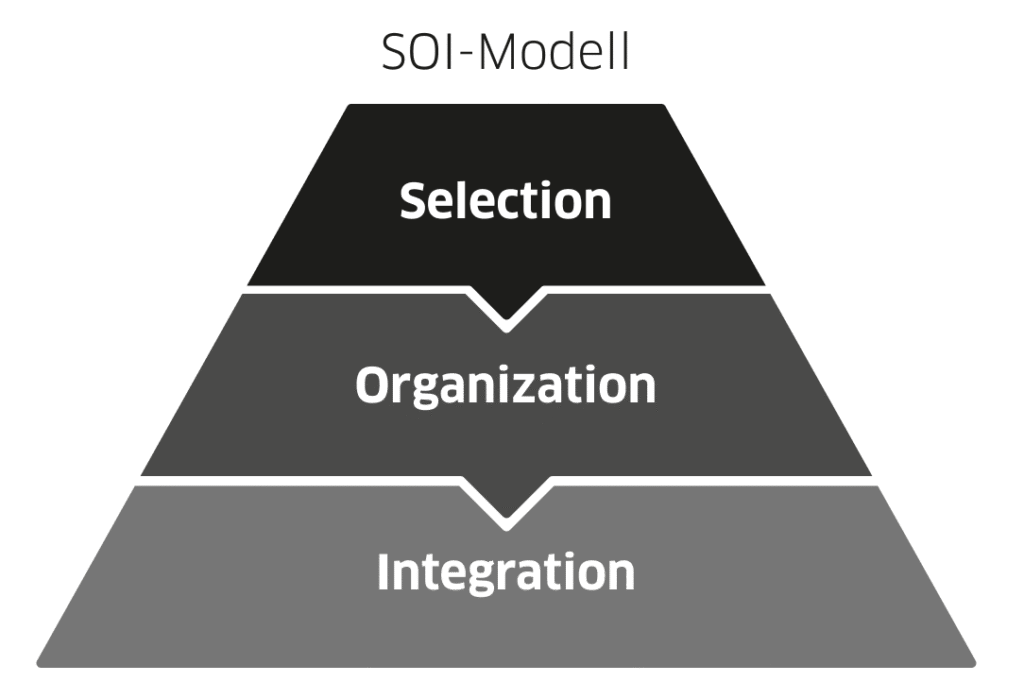
Richard E. Mayer’s SOI model gives generative learning a clear structure: selection, organization, integration. First, learners select relevant information. Then they organize it into meaningful connections. Finally, they integrate the new material into their existing knowledge. You can deliberately support each of these three stages, for example with prompting, structured tasks, or visual mapping.
Principles for generative e-learning
Concepts from generative learning can be built into any learning module, as long as they are designed systematically and grounded in sound instructional design. Key principles include:
- Activating prior knowledge: Before learners dive into new content, their existing knowledge structures are deliberately activated.
- Words and pictures that fit together: Representations complement each other. What matters is what learners do with them mentally, not how many media you use.
- Generative learning activities: Learners work on tasks that require them to rephrase content, visualize it, or put it into their own words.
- Metacognitive monitoring: Reflection phases help learners observe their own learning processes.
Tool-based examples of generative learning
Modern authoring tools offer many ways to put generative learning into practice. A few examples from our work:
- Free-text fields: Learners answer “why” questions or explain processes in their own words.
- Concept map interactions: With tools like MindMeister or MURAL, learners can link freely movable terms into knowledge networks.
- Language analysis in open-answer tools: Learners write definitions or examples, and automated feedback systems respond. The subject-matter accuracy of that feedback needs to be checked.
The crucial point is that the learning platform isn’t just a container for content. It’s a catalyst for generative sense-making. In their research review, Fiorella and Mayer describe eight generative learning strategies, including self-explaining and drawing. How much they help also depends on the guidance and the task; activity alone isn’t enough.
Limits and conditions for success
Generative learning doesn’t work on autopilot. Without a clear task structure, sufficient prior knowledge, and targeted guidance, its potential fizzles out. Just as important is learners’ motivation to engage. Research in educational psychology indicates that learners are more willing to invest cognitive effort when they see meaning in what they’re learning.
For e-learning, that means authenticity, meaningful tasks, and feedback are essential. Digital courses should leave room for reflective learning, with feedback tools and peer interaction. If you want to use generative learning, you need to plan with real instructional depth.
Conclusion: generative learning as the key to deeper understanding
Generative learning in e-learning opens up a way to make learning richer, more lasting, and more active. It challenges people to think, and that’s exactly where its strength lies. For instructional designers, L&D strategists, and e-learning managers, this means: if you develop your own content, make cognitive activation a priority. Learning isn’t the mindless consumption of knowledge. It’s construction.
At breed.design, we try to put Mayer’s findings to work in our digital learning design by building in interactive activation like this again and again. That helps learning success last.