

Our services
Learning journeys and blended learning programs
A learning journey is a learning program made up of steps that build on each other: digital training, an explainer video, a live session, an on-the-job assignment, and spaced review. We design and produce these programs so your people make what they learn part of their daily work, instead of just passing the final quiz.
Where we help When you want to take a holistic approach to corporate learning
- 01
Your topic takes practice, like leadership, communication, or sales, and a single course won’t cut it.
- 02
You run strong classroom training and want to add digital prep and follow-up.
- 03
You want new hires to settle in over several weeks, not on one overloaded first day.
- 04
Compliance knowledge needs a refresher every year, without everyone starting from scratch each time.
- 05
You want to know whether a program makes a difference, not just how many people completed it.
What we do for you
Design the journey
We define which steps your program needs, in what order and at what intervals they follow, and what happens online, live, or right on the job. We build on what learning science has clearly shown: people who space out their learning and actively recall what they know retain more than they do after one long training block.
Combine formats
Every format has its strengths, and we use each one deliberately:
- Short digital modules (microlearning)
prepare learners and serve as a quick reference later on.
- Learning videos
show what something looks like in practice, from a difficult conversation to a hands-on task at the machine.
- Live sessions
make room for discussion, practice, and questions.
- On-the-job assignments
carry what people learn into their everyday work.
- Knowledge checks and spaced review
keep knowledge fresh and in use on the job.
Drive learning transfer
What matters most happens between the learning steps: your people put what they’ve learned to work. To help, they get a concrete task for their daily work, a few reflection questions, and a nudge at the right moment. What they practiced in training should work the next time it counts, whether in a customer conversation or at the machine.
Bring in the platform and AI
Your learning journey runs in your existing LMS or on notch.learn, our learning platform. Along the way, an AI learning companion can support your people, for example with practice questions on your content, deeper dives into a topic, or a quick reminder at the right time.
Measure impact
Right from the planning stage, we agree with you on how you’ll recognize success: how participants respond, what they learn, how they apply it on the job, and what it delivers for your business. Those are the four levels of the Kirkpatrick Model. → Article: The Kirkpatrick Model in e-learning
Three typical learning journeys
Onboarding over the first few weeks.
Even before day one, a short video welcomes new colleagues and covers the essentials about the company. Or the welcome comes straight from your executive team. Over the first few weeks, new hires get to know processes and systems in bite-sized modules, tackle their first tasks together with their manager, and meet others who have just started. At the three-month mark, there’s a check-in: What’s already running smoothly, and where is more support needed?
Leadership development program.
A foundations module creates common ground. Then participants practice difficult conversations, first in digital scenarios and then in live training, before taking an on-the-job assignment into their next real conversation. Short refreshers between sessions keep what they’ve learned top of mind.
Annual compliance training.
In year one, everyone goes through the full training. From year two on, it starts with a pre-test: anyone who shows they know the material only works through what has changed. That saves your people a lot of time, and compliance training stops feeling like a tedious rerun.
From our projects
Brainfood Academy: microlearning that follows learners into the workday.
For the Brainfood Academy, we created more than 100 microlearning courses with over 26 hours of learning content on leadership, communication, sales, and self-management. Afterward, an AI learning assistant supports learners in Microsoft Teams with short exercises and spaced reviews. More than 10,000 people used the program in the first twelve months.
Pasani Academy: compliance training that adapts to what you know.
A pre-test shows what learners already know. Anyone who demonstrates that knowledge skips the corresponding modules. When new legal requirements come in, those modules become mandatory again. As a result, training time dropped by 50% in the second year and by 70% in the third.
PUMA: right on time, every year.
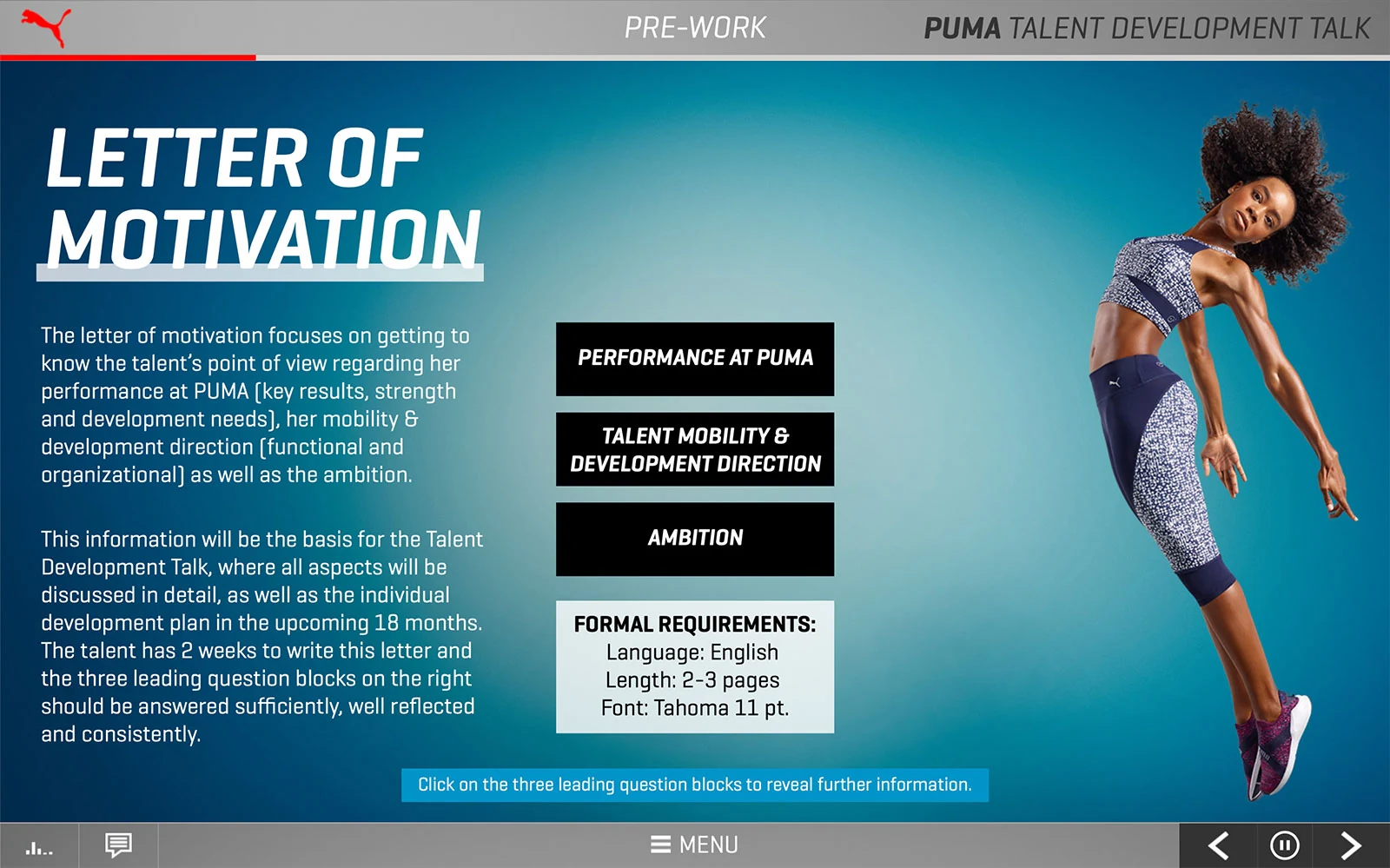
The conversation training for managers kicks off each year just as talent development conversations begin, with targeted invitations and reminders. So the know-how is fresh when it’s needed.
Our approach
From learning objective to launch.
01
Understand
We clarify objectives, audiences, existing content and technical requirements.
You receive learning objectives, a defined scope and a reliable plan.
02
Design
We develop the structure, interactions and visual design. An early prototype brings the training to life.
You receive a storyboard and prototype for approval.
03
Build
We create the text, media and technology in agreed stages, with feedback rounds and quality assurance.
You receive the tested training, in multiple languages if required.
04
Launch
We integrate the training into your LMS, support the launch and continue to develop it with you.
You receive training that is live and in use, with an evaluation of its impact if required.
What does a learning journey cost?
The scope depends on how many steps the program has, which formats it uses, how much video and how many live sessions it includes, and what you already have in place. As soon as the design is set, we’ll send you an estimate, before production begins.
Frequently asked questions
What’s the difference between a learning journey and an e-learning course?
An e-learning course is a single building block. A learning journey connects several building blocks over weeks or months and ties them into people’s everyday work.
What is blended learning?
Blended learning combines digital learning with in-person or live formats. For many topics, it’s the most effective approach because each format does what it does best: knowledge transfers well digitally, while practice and discussion work better live.
Can we include our existing classroom training?
Yes, and that’s often the starting point. Your classroom training stays in place, and digital steps before and after it help more of it stick.
Do we need a new learning platform for this?
Usually not. Most learning journeys can be built in an existing LMS. We check whether that works with your system right at the start.
Tell us what you need. We’ll find the right solution.
Whether it’s a single course, a learning journey or a learning platform like notch.learn, our first call is about understanding what you need and how we can help.